Dominic Young

Writings and more

  • Google wants people — and companies in particular — to use its AI systems. There’s a problem, though; AI companies currently stand accused of industrial-level copyright infringement by helping themselves to untold amounts of content found online and using it to train their systems.

    What company would want to rely on and pay for a tool that might turn out to be built on an infringement? What will that mean for the user? Will they be sued too?

    Google is attempting to reassure the market by promising customers that if they get sued, Google will step in to cover the costs.

    Why would the technology giant do this?

    Perhaps it is confident of winning any lawsuits and this is just a way of calming jitters and signing deals.

    Or maybe it feels sure that legislators will smooth the path for it and adjust the law in its favour — all the company has to do is wait.

    But such levels of confidence would be shared by almost nobody: the law and precedents are not clear cut, and Google would need to prevail in multiple jurisdictions in order to avoid all legal jeopardy. The likelihood of this happening is close to zero.

    Content from our partners

    Rules of the game

    Google’s position is more chutzpah than confidence; the company is playing chicken with this issue, keeping control over what happens and dealing with the consequences as they arise.

    The game of chicken is one at which Google — and many others in Silicon Valley — excels. Historically it has tended to win. I have done a few of these as well.

    Here’s how to play: Picture two vehicles driving towards one another on a road, you’re driving one, your opponent in the other. Unless one of you swerves, there will be a huge crash.

    The first thing is to assess the size and weight of the opposing vehicle. The bigger it is and the more weight it has onboard compared to yours, the more likely you’ll be obliterated in any collision, while they escape with minor damage.

    If you’re in a small car, facing a 40-tonne 18-wheeler, you’ll always swerve. Even if you leave it to the last moment, you’ll lose your nerve but keep your life. This is why Silicon Valley loves this game and always expects to win.

    They load trucks with confident assertions; massive amounts of money; armies of lawyers who can attack on multiple fronts; immense, rapid and seemingly unstoppable adoption of their systems; endless reserves of fuel and supplies. Then they hit the gas. They seek to create massive and constantly increasing momentum behind whatever they’re doing and dare everyone else to get out of the way.

    Even when they’re up against a swarm of opponents, none of them have the same resources and they aren’t coordinated collectively. A few get splatted on the windscreen; others are smashed under the tyres and the rest swoosh past and try to regain their stability in the turbulent slipstream of the thundering juggernaut.

    It makes sense that, in gearing up for another round of Silicon Valley’s favourite game, Google is adopting old tactics — which might be why it is offering to indemnify users.

    Every indemnified company becomes part of Google’s payload and can’t undermine the giant by going off and settling a legal case. Google stays firmly in the driving seat. AI becomes more widely adopted until in some ways it becomes essential.

    Google needs the idea of a world without AI — even if only temporarily while it is made legally compliant — to be unthinkable. That adds more momentum and weight to the AI juggernaut and raises the stakes for anyone trying to stop it. Google needs AI to be something that if blocked will create a huge hole within the internet. So, it needs to be adopted, as widely and quickly as possible.

    Hence the indemnity, without which few commercial customers would feel comfortable. However much it ends up costing Google, the alternatives would be worse.

    Stupid games, stupid prizes

    This game of chicken, though, is different — and one that Google might lose. The momentum approaching in the opposite direction is bigger and more focused than ever before.

    First, the rightsholders of the world are absolutely unified in their position that the use of their content for training AI systems is a breach of copyright-no ifs, buts or maybes to be heard. Everyone has the same position. They have some legislators on board, too. This is no swarm of insects.

    Second, the law is not on Google’s side. Even if — and it’s a very big if — it can make the case that, under the US’ absurd “fair use defence”, this exploitation is somehow fair, Google will still have the rest of the world to worry about. For its commercial services to be widely adopted, it needs its AI use to be legal everywhere, not just in the US.

    In territories like the EU, there are no conveniently vague legal principles to spend years and millions of dollars arguing about. In the EU, the use of scraped content to train AI is only legal if the owner hasn’t explicitly disallowed it. Which, increasingly, they have.

    This makes unlicensed use of EU content largely illegal and makes commercial exploitation of unlicenced AI systems there very risky or impossible.

    If Google loses in the US, things are far worse. US laws allow for damages of up to $150,000 per item for registered copyrights that are “wilfully” infringed. Even the mighty Google, with its huge cash reserves, can’t afford too many of those penalties — training databases include, reputedly, billions of items.

    So, who is going to win this game of chicken?

    Google may have to, and perhaps for the first time, swerve. This is one collision it can’t be sure it will emerge from unscathed. The consequence will be a reboot of the way the AI market works, with training data licenced from rightsholders and a new generation of rights management technology, commercial marketplaces and revenue models arising to support it.

    This will undoubtedly produce a better and more equitable outcome in the longer term. Google’s truck will take some damage as it trundles off the road; it will have to compensate for past infringement, put its tech on pause until the legal frameworks emerge, persuade rights owners to do deals and share the data and revenue that its AI business develops over time. Other AI players will find it easier to enter and join the market with products differentiated by specialist capabilities and the specific training data they have used.

    But Google and the other AI players will survive and still thrive. More importantly, so will the internet’s apex value-creators: creators themselves.

    In this game of chicken, the creative industries and all creators need to stay tight. We have the momentum of the law, the legislators and the immense value of work behind us. Without us, AI systems are worthless. With a fair and collaborative new marketplace, we will all be enriched. We can win this one.

    Email pged@pressgazette.co.uk to point out mistakes, provide story tips or send in a letter for publication on our “Letters Page” blog


    Originally published at https://pressgazette.co.uk on November 2, 2023.

  • In his Declaration of the Independence of Cyberspace in 1996, American poet John Perry Barlow wrote: “Governments of the Industrial World, you weary giants of flesh and steel, I come from Cyberspace. On behalf of the future, I ask you of the past to leave us alone. You are not welcome among us. You have no sovereignty where we gather.”

    He largely got his wish. Governments worldwide enacted legislation exempting Internet platforms from laws that otherwise apply in the world of flesh and steel he despised.

    We have been living with the consequences ever since. Digital platforms have operated on largely self-written, self-serving rules, creating an environment optimised for their profits. Unencumbered by many laws that still bind the rest of us, they have thrived.

    The information superhighway we were promised in the 1990s is here, albeit riddled with potholes, diversions, dead-ends, and bandits happily and profitably peddling disinformation, clickbait, deep fakes, malware, spyware, ransomware, and scams. We have become used to finding what we’re looking for buried under promoted links or mounds of ads.

    We all need to keep our guard up, all the time, online. Barlow’s digital utopia has become a digital swamp.

    The lesson of the Internet to date is this: If you abolish rules, you breed anarchy.

    What it means for the news industry

    The news media industry has struggled to survive. The big platforms leached away its advertising income while other credible revenue streams remain frustratingly elusive. New competitors for peoples’ attention have commoditised its content, even as audiences have become larger than ever.

    Despite remaining an essential part of any functioning democracy, the news industry has been relentlessly diminished by the Internet.

    Fears are growing that this pain will become even more acute with generative AI. This technology’s automated output is indistinguishable from that of creative people. It exploits the work, investment, and creativity of human creators without asking — and without paying. This is a truly parasitic technology.

    Should AI firms be allowed to leach away creative content and revenues, converting them into income as the big platforms have done with advertising?

    Of course not. The implications are huge and, unlike during the formative phase of the Internet, they are also obvious.

    This is why the creative industries have moved quickly to prevent history repeating itself. Musicians, photographers, artists, filmmakers, authors, publishers, performers, actors … every sector whose existence depends on earning money from creativity has voiced outrage at the industrial theft that became obvious as generative AI tools were released into the wild. Many moved quickly to protect their work. The scene is set for a series of showdowns, in courts and legislatures around the world, to try to define the rules for this new technology.

    The power of copyright

    The central issue, as I see it, is simple. While scraping content (copying it from the Internet and stashing it in private databases) is commonplace, that doesn’t make it legal. AI is doing the same thing as search engines — making copies of what it finds online — but what AI does with the content isn’t the same. What it is doing is certainly not ethical or, in my view, legal.

    I believe that, when it comes to AI, copyright will prevail. AI training, after an anarchic start, will have to be done within the law; permission will need to be sought and given. A framework, technology, and marketplaces to enable this will emerge.

    There are good reasons to be optimistic about this point. Even if laws vary from one territory to another, any AI business that wants to operate across them must comply with the most stringent to avoid legal peril. Additionally, AI firms will need to reassure commercial customers that using their systems does not create legal risks for customers. This, in turn, will need the certainty of licences and contracts to underwrite their warranties.

    This promises that the next generation of AI systems will be better, fairer, more transparent, more competitive, and, most importantly, legal. AI firms will become more diverse, specialised in servicing different verticals in different global markets and performing different functions, and therefore becoming more competitive.

    With control of the rights that copyright law gives them and that early Internet law substantially took away, creators will be able to choose which — if any — AI may use their work. They, and all of us, will be literally and figuratively richer.

    Cleaning up the Web

    But there is work to do. AI technology isn’t going to start behaving itself just because new rules get written (or old ones get re-asserted). Nor can we be sure when those rules are going to become clear.

    That’s because AI technology isn’t limited to compliant companies in democratic jurisdictions. It’s also available to, and already being used by, those who care little about regulations emanating from the United States, Europe, and the UK and whose location keeps them out of reach. Those AIs are going to operate according to their own rules regardless.

    Everything on the open Internet will be fair game to them. They’ll carry on using it however they want. On the Internet, as we all know, nobody knows you’re a dog — or a bot farm, or a government information warfare operation, or a criminal enterprise.

    This means the use of AI for nefarious purposes is unstoppable. The creation of garbage will be supercharged by AI, so we can expect even more of it to flood online for the foreseeable future.

    The Web, already dirtied and polluted, is going to continue growing murkier. Is it a lost cause? Not if we actively choose to change it.

    Opportunities for change

    One opportunity for change lies in creating online spaces that are not polluted. In these spaces, any AI use will need to be constructive and transparent, overseen by accountable humans. We can help people distinguish what is safe and trustworthy, and avoid unwittingly stumbling into the online mire.

    Certainly, as the estate responsible for discovering, validating, and communicating new facts, the news media becomes indispensable — and the opportunity for it to get even stronger, and play an even more central role in democracy is huge.

    First, we need to win on copyright. We need to start preparing for an era built around the rule of law, where the idea of permission exists, managing permissions is possible, and markets emerge on terms lawmakers can control.


    Originally published at https://www.inma.org on November 1, 2023.

  • Opinion

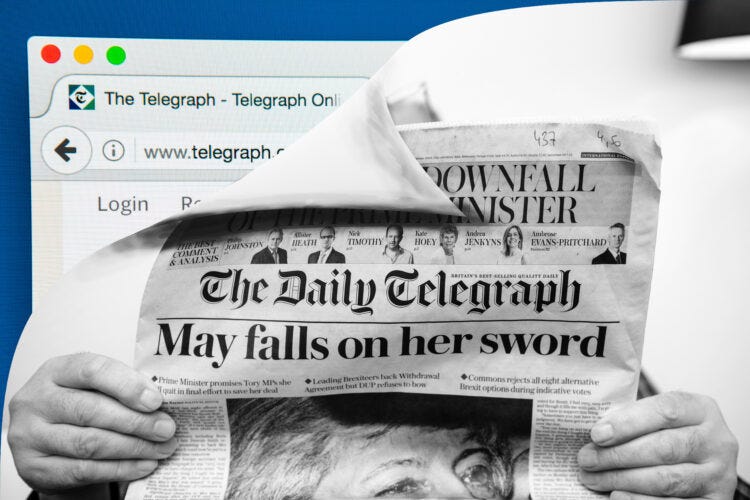
    The Telegraph looks on course to hit its bold ‘one-million subscriber’ target, but at what cost? And what will happen next?

    In moving to a subscription-first strategy in 2018, The Telegraph set a target to boost the ailing newspaper’s commercial fortunes with a target of reaching ‘one million subscribers’ by 2023.

    With DMGT now confirming its interest in buying the title, just weeks after the release of glowing profit figures, the Telegraph has now celebrated hitting its one-million target (subject to auditor confirmation, expected in October). This has raised eyebrows in some quarters as to how those numbers stack up — but it’s an achievement nonetheless.

    The average subscription rate across the news business, based on most of the conversations I have, tends to hover at around two to five percent of the total audience.

    With a total audience of 25 million unique visitors per month (in 2017), the paper would need to convince just four percent of its total audience to subscribe in order to hit that magic one million.

    Irrespective of whether you align with The Telegraph ‘s values, they had reason to dispense with their traditional conservatism when it came to their growth prospects. It’s a powerful, traditional media brand that employs excellent journalists, and its editorials carry considerable weight.

    And as Raymond Snoddy pointed out in his column last week — there is space for such a title in the market; it may also have an ageing audience, as is common with most newspaper brands, but it’s a loyal one.

    So, with a focus on building a strong acquisition and retention model, using modern digital tools, you can understand the optimism.

    What happened?

    In 2020, the paper passed the 500,000 milestone and finished 2021 with 720,000 — in part, I suspect, given the overall growth in subscriptions during the Covid pandemic but incredible progress nonetheless.

    Modest growth in 2022 saw this number grow to just 733,731 by the year end, and the latest figures show the numbers grew to 767,833 news subscribers by the end of June 2023 (though it should be noted that this number increases to 974,709 when new acquisitions and spin-off products such as crosswords are included, or drops to 586,288 when digital duplicates and free trialists are omitted from the total).

    So is this good or bad?

    The business set a bold strategic target and appears to be on course to meet it. This is not easy to achieve in a market where subscriptions are clearly starting to plateau, even if the numbers have been boosted by an acquisition.

    Revenue-wise, the Telegraph ‘s numbers show that average revenue per reader has dropped by 14% during 2023, presumably as a result of excessive giveaway promotions — currently, the paper is offering a three-month subscription at just £1 per month — and perhaps due to lower revenues per user from the newly-acquired titles.

    It’s not yet clear how advertising revenues have been impacted in 2023. Across the entire media sector, income is down, owing to advertisers pulling back on marketing spend in tight economic times and the continued haemorrhage of market share to the social media platforms. Even more pop-ups can’t be the answer; the potential gains are small.

    Increasing reader revenue has to be the focus, and here, the Telegraph is on strong ground as it has a product that people are willing to pay for.

    The newspaper continues to win plaudits and gain readers, most recently for its coverage of The Coronation and the Matt Hancock WhatsApp scoop, and continues to be profitable.

    It will be interesting to see what the next target will be, especially if the paper drops its relentless mission to gain one million subscribers and focuses instead on overall reader revenue.

    The numbers suggest that subscriptions would naturally plateau at around the 500,000–750,000 mark without the discounting, and I would suggest that average reader profit would skyrocket; with less spend on performance marketing to close short-term sales, and less churn as the new customers you do acquire are acquired at a price they are willing to pay on an ongoing basis.

    You’re less likely to see loyal full-price subscribers churn out and re-sign to get the offer again, or be made to feel like fools for their loyalty. Swapping five new ‘give it a go at a pound’ laggard late adopters for one loyal ten-quid-a-month subscriber makes good business sense to me.

    And at this point, I, of course, have to mention the idea of adding per-article payment to the mix; we know that pay-as-you-go is effective both as a subscriber-acquisition mode and a way for generating revenue from the 95% of casual visitors who come to the site and may be prepared to pay something but not be ready or willing to sign up for a subscription.

    One million subscribers are well within reach, but at what cost? I’m intrigued to see what happens next.

    Dominic Young is the founder and CEO of digital news micropayment tool Axate. He was previously a newsbrand executive at News Corp.


    Originally published at https://the-media-leader.com on August 22, 2023.

  • With subscription growth stalling for many publishers, offering a pay-as-you-go option should be a no-brainer for digital publishers. Some, though, are worried about disturbing their so-called “zombie” subscribers and prompting them to cancel. Here, I explain why worrying about the zombies can blind publishers to bigger opportunities.

    Every subscription business has zombie subscribers. They’re customers who are paying every month but using the service infrequently or not at all.

    How many of them do you have? How do you manage them? Some publishers avoid ever contacting their zombies, fearful of reminding them they’re paying for something they rarely or never make use of. Nearly all publishers make sure that cancelling a subscription is a lot harder than buying one. Some people will just give up and forget to try again.

    That fear is understandable. Every subscriber is a guaranteed monthly payment, after all. You might be embarrassed or even a little ashamed that you’re taking money from people who get little or nothing in return, but the bottom line needs them to stay.

    You might also be even more embarrassed, privately, at just how many of them there are. In a Q&A with Better News, the Arizona Republic stated that 42 per cent of its subscribers were ‘zombies’ while a separate, wider, study cited in Poynter indicated that the average in US news may be as high as fifty per cent. Wow.

    That embarrassment, though, is being overwhelmed by cold reality. Many publishers are struggling to acquire new subscribers at the moment, and when they succeed they usually do so with the help of discounting. Subscribers acquired recently, in general, are less lucrative and shorter lived than the early adopters. At some point every subscription simply runs out of customers. The publisher currently offering me a 4 month trial for £0 has probably reached that point.

    Which makes zombies a pretty important part of the revenue mix. But for how much longer?

    Economic pressures are triggering a wave of subscription cancellations. Everyone is seeing it, even the big streaming platforms which give their users far more, in terms of time spent using the service, than any news publisher.

    Regulations, too, are creating pressure, with the age-old but not very reputable practice of forcing users to make a phone call to cancel now being outlawed in various parts of the world.

    Plus, we are seeing banks make a virtue of their ability to spot subscriptions in their customers’ transactions and cancel them by the simple method of stopping payments. No phone call required.

    All this is set against the reality that, in most markets, fewer than 5% of the audience will ever sign up for a subscription. Many publishers have already found them all.

    The game is up, it seems, for the traditional approach to subscriptions. Achieving renewed growth, or even just arresting decline, requires a different way of doing things.

    A pay-as-you-go option is the best way of addressing this issue. Without the commitment of monthly payments, customers never really “churn” and they aren’t locked out. They just pay whenever they visit. If they want to stop paying, they just stop showing up. Your job as a publisher is to constantly tempt them back.

    Instead of discounting your price, you have discounted commitment. This not only fits better with the current shrinking state of the market — not to mention regulatory changes — it extends your potential customer base far beyond that 5% to now include everyone who might want to dip in every now and again.

    We built Axate to address this need. We’ve found from our experience, and from user feedback, that casual readers who come back often are more likely to upgrade to a subscription later. We also know that subscribers who churn are likely to remain as occasional, casual, customers. Some of them will spend more than they did as a subscriber. They’re all still customers, and every time they visit you make a bit more money.

    Which begs the question: why is it that so many users — even subscribers — visit so infrequently?

    That is more to do with your produ​​ct than the business model. In a less committed world, your product needs to do a better job of being an essential part of its customers’ day.

    Talking about that is for another article, but knowing how much opportunity can be unlocked by simply increasing frequency is a pretty exciting motivation for trying some new things.

  • It took a long time for the news industry to really embrace the reality that they need consumer revenues to survive and thrive. Having reached it, though, a new pessimism seems to be growing. The initiatives that have been widely implemented aren’t working well enough.

    If we look at the language we’re using to describe those initiatives, it might give some us clues as to why. Publishers often talk about ‘paywalls’ as the solution. But walls are barriers: they keep people out. They protect what’s behind them, yes — and we should be protecting premium content, rather than making it freely available — but at the cost of keeping it hidden. This kind of language suggests a hostility towards the very people it’s meant to be encouraging.

    It’s a strange way to think of your business model, and hardly surprising that it’s not working as well as it should.

    Publishers also talk about ‘subscription’. A subscription demands a commitment from users, who we know enjoy the casual nature of their relationship with multiple brands online, and who naturally prefer to form habits rather than make formal commitments.

    I mention language not to castigate any publishers trying to make an income for themselves, but to highlight how important it is to think about business strategy from the point of view of the consumer and not just the business.

    So let’s look at the current situation in more positive terms. What the news media — and all media — needs is payments. What consumers need is the ability to continue to access whatever they want to, at a price they find acceptable, without the need to make commitments they aren’t ready to make.

    And what we definitely don’t need is to fall into the same trap of negative language to describe that simple solution. Direct payment systems that allow consumers to pay for only the content they read, on a per-article basis, are often referred to as ‘micropayments’. But micropayments are just payments, dressed up in a daunting buzzword: we didn’t call payments “micro” when they were people handing 25p over in a shop for a printed newspaper. There’s simply no need to use such negative, alienating language to describe a system that people are already familiar with.

    The language doesn’t need to change around payment, but attitudes do. Studies have shown that people are becoming increasingly habituated to paying for online content, and will soon be replicating that habit with their news sources. Publishers need to capitalise on that willingness with a simple, easy to use system that works for them and for their readers. That’s why we’ve invented Agate: to meet that need, and to offer a more positive and sustainable future for online media.


    Originally published at https://www.axate.com on November 27, 2023.

  • The news industry is facing a crisis, and it has hit local and regional newspapers particularly hard. Print numbers are dropping, and online content isn’t making up the difference with digital advertising revenue. The figures look bleak: in the U.K, 198 local U.K. newspapers closed down between 2005 and 2016, with 40 going under in the last year alone. In the U.S., a shocking 1800 newspapers have closed in the last 15 years. Without the scale and reach of larger or national newspapers, many local news sources are struggling to generate enough revenue to scrape by.

    Local news isn’t suffering because it’s not useful or relevant. While its content can sometimes seem small scale in relation to the tumultuous politics of national news, local news plays a vitally important role in a democratic society. It directly serves the community it covers, and is a valuable, non-commoditised resource. Local journalism also plays a crucial role in holding power to account: earlier this year, local newspaper The Bristol Cable ran a campaign which prompted the Bristol council to take action in response. A study conducted in the U.K. discusses the potential for a ‘democratic deficit’ in areas where local newspapers have closed down.

    Similarly, one U.S. study found that local authority borrowing increased in areas where newspapers had closed down, resulting in huge extra costs for the taxpayer. Without local journalists investigating their projects and plans for spending, local authorities’ actions went unchecked.

    Some organisations, like the Lenfest Institute and Knight Foundation’s $20 million fund in Philadelphia, or the BBC’s licence-fee funded local journalism scheme, have organised charitable funding to prop up local journalism. It’s a well-intentioned idea, and it might work as a short-term fix. But propping up regional newspapers with charitable funding won’t enable a genuinely sustainable future for the industry.

    Local news needs to be self-sufficient to thrive in the long term. The move away from print editions to digital delivery has meant that local newspapers have lost a key source of revenue: their cover price. Reader revenue is a vital and mostly untapped potential income for online content, and could offer one solution to this crisis. Local news offers valuable content that readers are willing to pay for; they just need a way to pay for that content in a way that suits their needs as consumers.

    For local news, this ‘chicken and egg’ problem is particularly acute. People won’t be willing to pay for low quality content, but high quality content requires resources to produce. Local papers, fighting for their lives, have reduced their staff drastically, and the quality of their output and the reach of their reporting has suffered as a result. It’s going to require a careful application of resources to reverse that trend.

    If local news has a simple, seamless way to collected reader revenue at their disposal then that investment in product will not only be justified, but will also be their best chance at a long and successful future.


    Originally published at https://www.axate.com on November 29, 2023.

  • Lord Hall of the BBC observed at the Royal Television Society convention in Cambridge recently that the already crowded TV streaming market is about to get a lot busier with the entrance of Disney and others — like the BBC itself.

    His optimistic belief is that this will rebalance the market in favour of the new entrants and at the expense of established players like Netflix and Amazon. Users will choose the BBC for ethical reasons and because it — and other new entrants — will make its content increasingly exclusive to its own platforms.

    This is wishful thinking. Lord Hall, and seemingly the whole TV industry, is failing to stand back and consider how they can influence the direction which their industry is taking. Instead they are taking as axiomatic the business model of the first wave of disruptors — Netflix, Amazon et al — and accepting it.

    That’s a shame because the flaws in the current model become obvious the moment the consumer is considered. They all work by subscription driven by investing billions — customers have to promise to pay every month regardless of how much they watch. Most people are resistant to doing this over and over with more and more subscriptions.

    No problem, says Lord Hall — programme makers can just hold their content back and make it exclusive to their own streaming service. In other words, beat your consumers into submission if they want to watch something in particular.

    We know about this model, because it’s the same approach tried in the newspaper industry — with outlets thus serving less than 10% of their natural audience. It’s bringing a luxury goods mentality to a mass market medium. It doesn’t work.

    Broadcasters are driven, in the end, by audience. More audience means more money. The most popular programme makes the most profit. So broadcasters compete for the best creative talent to make the best programmes and when they have a big success, they benefit from it.

    When the audience makes no difference to the income, though, the incentives get a bit skewed. A user paying £10 per month pays £10 per month regardless of how much they watch. As long as they don’t cancel, they are producing revenue. That’s not the way to a sustainable future — certainly not for smaller late entrants to the market.

    What the TV industry needs to do is challenge the idea of subscription streaming services completely. If they want to get back to a business where consumer and producer incentives are both centred around creating the best programmes, doing it by limiting the amount a consumer can spend and limiting the audience you’re capable of reaching is a pretty awful starting point.

    What new entrants need to do is create an alternative market which is a lot more attractive to viewers than the fixed subscription behemoths: an open market with a universal way for users to pay.

    Programme makers should be able to compete for audience — and revenue — through the quality of their creative output and marketing. They should be able to set the right price for their particular offer, perhaps different for different programmes. They should ensure that the value chain is not owned and controlled by the distributors, and that regardless of distributor, their income is determined by prices and deals which they can control.

    That market model for newspapers and magazines exists via digital wallet technology, and it could easily be extended to TV and beyond. After all, media of all kinds collectively talk to the same audience — everyone. What’s the point of having countless different ways of dealing with customers?

    The opportunity is much larger than anything streaming can deliver, but doing so requires more ambition, imagination and self-belief than the UK TV industry has yet shown.

    Broadcasters won’t win a sustainable, competitive, growing future for themselves by trying to out-Netflix Netflix, or by fencing off their best content and only showing it to the lucky (or spendthrift) few.

    To be fair to Lord Hall, he has the advantage of guaranteed income and free-at-the-point-of-delivery services when trying to sell the BBC to consumers. But nobody else has those advantagesThey should take their destiny — and their revenues — in their own hands by rethinking their market and unlocking far bigger opportunities for themselves and their audiences.


    Originally published at https://www.axate.com on October 20, 2023.

  • I started Axate from a very simple realisation, formed when I was working as head of Strategy for Newscorp towards the end of the noughties. It was clear that any business model based solely on advertising couldn’t work; in the past, a big chunk of ad spend was guaranteed to newspapers, but the internet offered a lot more ways for advertisers to spend their money.

    Subscription was also appearing to be more of a challenge than first anticipated. It wasn’t the traditional business model of newspapers. Before, almost everyone read at least one newspaper a day, bought it over the counter, and almost no one formally promised in advance to do so.

    At the time, most newspapers were free online. When Newscorp took the Times behind a paywall, they were scoffed at — it took determination to make it the success many predicted it could never be. Efforts to replicate that success on more populist brands like The Sun stumbled. The model just didn’t fit with what the readers wanted.

    Fast forward to now, and not much has changed: there are a few newspapers doing well with subscription, and there are a lot of others struggling.

    ‘Payment’ and ‘subscription’ are still used synonymously by most in the industry, and the realisation that they are not was what led me to starting Axate. The problem isn’t that people object to the idea of paying, but that the level of commitment and hassle required overwhelmed their willingness to do it. Subscription just asks too much of most readers, whose real lives encounter news in many places, quite casually, quite frequently and quite briefly.

    You could say the inspiration for Axate came from the quick trip to the newsagent on the way to catch the train. How could we make paying for media online at least as simple as the digital equivalent of dropping a few coins on the counter when you’re in the mood for a particular title?

    Where are we now?

    Axate started as a a simple pay-per-article tool for online publishers. Our aims were — and still are — simple: give readers an easy, fuss-free way to pay, and give publishers a way to monetise the casual readers, who make up the bulk of their readership.

    Axate is a digital wallet: you upload some money and use it to pay for what you want to read, when you want to read it. You only sign up and input your details once, so you aren’t juggling yet another handful of passwords and log-ins (or the dreaded “enter your email address again” multiple times a day). Publishers know their product and audience best, so they should decide how much to charge per article and when to cap payment so that readers can get unlimited access to their site.

    Over time, publishers requirements evolved. They didn’t just need different pricing per article; they needed more flexibility. More and more local newspapers, who have suffered some of the greatest hits from the decline of the digital news industry, have shifted to a ‘day pass’ rather than payment per article alone. It’s their whole product which has value for their local readers, not individual articles, so charging people once for everything makes more sense for them — as long as the price is right. Using Axate that sort of experimentation and change was and is simple.

    Then, when the pandemic hit at the beginning of 2020, we witnessed an urgent need for access to timely, reliable and often localised information. Newspapers, particularly local ones, were more important than ever; at the same time, their main revenue source, advertising, collapsed. We quickly developed a ‘pay if you can’ tool for publishers to be able to offer readers important news for free, while still maintaining some income at a time they needed it best.

    Most recently, we introduced a subscription option to Axate’s tool kit. That means all the different ways to access a site are in the same place: casual readers can upgrade to a subscription, usually priced to deliver better value for money and benefits for frequent readers. If they want, readers can go back to casual payment — still spending money when they visit and without “churning” and being completely lost as readers and paying users. This is important for publishers especially now, when many new subscribers who signed up during the news-obsessed early days of Covid are now turning their attention (and spending) elsewhere.

    Where we’re going

    Axate isn’t just for news, of course, nor is it just about simple payments. When I started Axate, wearing my strategic hat, I thought a lot about the incentives driving what was happening in the market. It seemed to me that there was something very wrong when the incentives are driving publishers to one of two dominant business models, advertising and subscription, neither of which work particularly well for the bulk of their customers.

    Axate is designed to align incentives around a single force: consumer engagement. If more people reading more stuff generate more revenue opportunity, it can unlock new ideas and new approaches to delighting people with products they love and want to return to. Equally, if every customer can access every publication, the media can take advantage of its greatest hidden asset — its network. The network the news industry reaches (even without video, audio, music etc) is gigantic and engaged, so why does it generate such anaemic revenues?

    Axate’s whole approach, business model and commercial terms are all designed to activate that network and deliver incentives to drive long term growth and investment. Better products, more widely consumed, can make more money. New products, well launched, can instantly access a large and low friction audience ready to pay. There is no in-built upper limit to that market.

    Once you take Axate’s logic and apply it to other areas you can see it works just as well. We have huge potential in streaming media like video and podcasts, where a few pence will be spontaneously and willingly spent for content which people know will be great (and, perhaps, then won’t be interrupted by irritating and un-skippable ads).

    Axate is a network, fundamentally built around the needs of the creative industries and their audiences. It can act as one of the backbones of a “media layer” of the internet. Here, much of the high value and useful content and products generated by creatives and media companies can exist in a networked relationship with each other, powered by a rational economic model with shared incentives and driven by user demand and response.

    Given that network already reaches everyone online, it’s an exciting prospect.


    Originally published at https://www.axate.com on September 23, 2023.

  • Syndication deals are making a comeback. The New York Times, i newspaper and the Financial Times are among those striking deals, and more are expected. The move comes as news publishers look to take advantage of the big platforms standing back from steering the user journey through content and brand.

    Back in the nineties, my career started in newspaper syndication, so this feels like familiar ground to me. Our team licensed content from The Times, The Sun and other News International titles to various newspapers and magazines around the world. In return, we got money, and brand exposure to readers who we wouldn’t otherwise reach with our own paper-and-ink products.

    The internet, however, changed the meaning of the word “syndication”. Some of the things we used to think of as “syndication” became standard operating procedures for the internet, where companies like Google would copy all the articles from our websites and use them, in parts, in search results. At the same time, companies like Facebook would generate little summaries of those results when people posted links. Nobody paid us any money when they used our content, and newspapers weren’t sure what they thought of all that. Mostly, they decided that they would embrace it as part of the internet and try to make the most of it — traffic was highly valued, after all.

    Fast forward to the present day and that ambivalence has sharpened a bit. Nobody thinks Facebook Instant Articles, for example, is an essential part of their product mix now. Meanwhile, Google, and its ad revenue, is no longer an unthreatening panacea or unquestioned arbiter of internet norms. However, publishers still want to reach new audiences, expose their brands to people they otherwise can’t reach and — ideally — make more money.

    So, we shouldn’t be surprised by the resurgence of what looks like a distinctly old-fashioned, rational approach to syndication. This rush of interesting and innovative deals includes The New York Times licensing Amazon Studios to show its popular column Modern Life (more than 20 years ago I used to sell options to film companies for big features in our newspapers) and the i newspaper licensing material from The Economist and The Financial Times. We can only expect more deals to come, particularly as publishers increasingly need to think of creating products, not just making content.

    The news industry is moving into a more rational era, where business models are expected to deliver real tangible business up-sides. In this era, brands will want to maximise the return they get from their investment into their high-quality content. Traffic is good but revenue is better.

    Where they can find commercially attractive outcomes from partnerships with fellow media brands (including rivals), they’ll start to forge them. They are being aided by the big platforms, which are playing a less hands-on role in determining what news users view and ads they see. Publishers will find that there’s much more opportunity than mere syndication to be found. As the industry moves towards consumer payment as a primary business model, the mutual interest between news brands grows.

    Just as no newspaper wanted to set up its own chain of high street shops, preferring to be stocked alongside rivals in newsagents, the ability to move customers (and their money) around between media brands as opposed to in and out of social networks and search engines, will become mutually beneficial for news brands and their users. Outcomes will be decided by consumer engagement, their delight driven by high quality products, and the reward for quality will be revenue.

    What we’re seeing is exciting innovation, determined by the needs of consumers and creators, in the vanguard of the third, rational, era of the internet. Like many exciting changes, it’s not a radical reversal of the status quo, but a response to evolutionary pressure which will accelerate.

    The first era of the internet was about experimentation. The second era, now drawing to close, turned out to be about exploitation. Our eyes are opening to what that means now the third era is upon us — it’s about what’s good for everyone.

    Dominic Young is the founder of Axate, which he started after 20 years in the commercial news industry holding leadership roles at News International and the Newspaper Licensing Agency​.


    Originally published at https://www.thedrum.com.

  • It wasn’t long ago that an announcement of Apple’s ‘events’ would trigger a flood of media commentary on what the next wave of devices would look like. This time it’s slightly different, with the focus almost entirely on what services it may or may not launch.

    Most of the attention has been on TV, and whether we can expect Apple to mount a serious challenge to Netflix with a new streaming offer, in the way Apple Music has started to challenge Spotify. Having spent 20-plus years on the commercial side of the news business at News UK I’m more interested in the mooted publishing product, which has attracted a little less attention.

    This wouldn’t be Apple’s first attempt. Having discontinued its ‘Newstand’ subscription product, its free Apple News service is peripheral at best, and Apple is expected to announce a revamped, subscription based, Apple News product today (25 March).

    The reaction from the publishing community has been lukewarm. The leaks on the commercial terms suggest Apple intends to keep 50% of the subscription fee, sharing the rest with participating publishers. This has caused understandable controversy, and Apple may stand accused of being greedy.

    But the bigger question is whether this business model can work.

    As one source put it, unlike music, “no-one wants an all-you-can-eat magazine service” and that “magazines are passion points, whereas music, you do want a library”. But even if there were customer appetite for such a service, the model is still flawed because what’s good for Apple is not the same as what’s good for publishers.

    Marketplaces work better when incentives are aligned. When what’s good for the distributor, say, is also good for the supplier and the consumer.

    What Apple needs is more subscribers. Its share is guaranteed, so more subscribers means more cash for Apple. But not, necessarily, more cash for publishers.

    Apple doesn’t need to care how much content a user consumes, as long as they keep subscribing. So Apple wants to make sure users get a lot of stuff for their money.

    That stuff always costs Apple the same. Whether Apple divides the publishers’ share up into 10 chunks, a hundred or a thousand, the cost to Apple never goes up.

    Publishers, of course, have to invest in content. When it comes to getting paid they’re at the mercy of an algorithm, uncertain and variable. Apple, having used the publishers’ products as the lure, can relax and see its profits increase. But for publishers to thrive, they need a reliable way to connect their popular success to their revenue.

    Joining a blanket subscription service is not it. Publishers can’t set prices. Every product sits alongside all the others, in an all-you-can-eat media buffet. If the service is an aggregator, combining content from multiple publications into personalised feeds, publishers can’t control their product either.

    It’s easy to understand why some publishers are keen to latch onto any new source of revenue, especially if they know a standalone subscription offer either won’t work for them, or can only appeal to the 2–5% ‘die hards’ in their readership at most.

    But imagine if the popularity of their product directly drove their revenue again. If publishers could control their pricing as well as their product, selling twice as much would mean making twice as much money. Or sell a hundred times as much and make even more — scalability works for media too.

    Such solutions are now being developed and made available because there has never been a better moment to challenge the internet orthodoxy — both publishers and consumers alike are discontented.

    But what options are there? Subscriptions are a big commitment for consumers. Outside the media industry and ‘news junkie’ elite, how many people buy even one newspaper or magazine subscription, let alone two or more?

    My firm belief is that there’s a ‘middle majority’ of casual readers out there who may not want to subscribe to every title they want to read, but who would pay something for the articles and products they really want to. Certainly a greater fee than that user could earn from advertising revenue — most of which, The Guardian’s David Pemsel has frequently pointed out, does not go to the publisher anyway.

    In my view, publishers need to find a way to charge for content without demanding a subscription. That way, they do best when they make the best product they can. Attract attention to it, set a price which works, get consumers to form a habit which keeps them coming back. Then consumers spend more, and publishers can invest in making the product better and more appealing.

    But can you ever find enough customers to make this work?

    Well, yes. They’re everyone. Publishers used to find them in newsagents. You never put your own shop on every high street; you put your product where the customers were.

    And the internet is the biggest newsagent ever built. Publishers don’t have to build their own shops.

    Unlike Apple’s model, the same thing would drive everyone’s bottom line. The best product stands to make the most money, but not at the expense of someone else’s revenue.

    Apple’s model, by contrast, limits the value of each user and, thus, of the total market.

    If the rumours are true, most news publishers are yet to commit to Apple’s service. I hope that’s right, but I also hope they have not become fixated on Apple’s 50%. That’s not the problem; even if Apple reduces its percentage, the issues facing publishers today remain unanswered.

    30 years on from the birth of the web, its inventor Sir Tim Berners-Lee has struck a glass-half-full, cautionary tone. There’s still much to do.

    Paying for media online remains awkward and fragmented, which has created a vacuum that the mass-subscription model has tried to fill. Great for the tech giants but not so good for everyone else trying to build direct relationships with their customers and, in the case of publishers, the revenue that’s essential to fund high-quality journalism. They need to stay focused on making great products that a middle majority of casual users are willing to pay for, and building a direct relationship with them.

    Resist the quick-fix overtures of the tech giants — it’ll be better in the long term.

    Dominic Young is the founder of Axate, which he started after 20 years in the commercial news industry holding leadership roles at News International and the Newspaper Licensing Agency


    Originally published at https://www.thedrum.com.