Dominic Young

Writings and more

  • The value of news to its primary audience is highest, but the ability to generate revenue to news publishers is at its lowest. How can we fix this?

    In times of crisis, people need reliable, informed and accurate journalism. That journalism needs to be accessible to the widest possible audience, both on a national and local level, and particularly accessible to those most vulnerable.

    Many publishers have partially dropped their paywalls in response to the recent COVID-19 pandemic, allowing their readers access to urgent information in the interests of public safety. The rate of digital news being consumed — both in page views and time spent per article — has been steadily rising since the start of the crisis, and has jumped up by over 50% in the last few days for some US publishers. It’s a time when readers need journalism the most.

    But reliable, high-quality journalism costs money to produce. And when the situation is developing as quickly as it is, and with restrictions on newsrooms preventing usual ways of working, the cost of keeping readers updated is high. Typically, publishers supplement free-to-read content with advertising revenue; but advertisers have blacklisted terms relating to the pandemic to avoid any potential negative brand association, leading to a massive collapse in advertising revenue.

    It’s not realistic for news to be free, but it’s also not realistic to expect every reader to subscribe to every site they want to see: now, more than ever, readers want and need a plurality of sources and opinions. In particular, readers need access to local news sites as well as national titles, so that they can monitor developments in their community and the changes that will affect them the most directly.

    Advertising-dependent publishers, responding the best they can to this crisis, have been left in some cases with little to no revenue. With paywalls down for the news most in demand, and advertising revenue crashing, the industry has found itself in an unprecedented, rather unique situation: when the value of news to its primary audience is highest, the ability to generate revenue to news publishers is at its lowest. With this crisis set to last months, this new status quo isn’t sustainable for long.

    This current emergency has highlighted the absolute necessity of news to society on a local, national, and international level. It has also highlighted the unsustainability of the industry’s current business model, and the necessity of changing the model to one that stands up in times of crisis and can protect journalism when we need it most.

    The overall unsustainability of the status quo is the reason we created Axate. Casual, uncommitted, frictionless payments for media open up more products to more users and vice-versa. A straightforward relationship between publisher and consumer, independent of advertising and with few if any barriers to entry, is simply a more sensible way — not just now, but even after the crisis has passed. And, in response to the unique situation this crisis has brought about, we’ve added the new functionality: the option to ‘pay if you can’, letting readers support publishers but without locking them out of urgent information.

    In the last week, we’ve seen the existing orthodoxies around internet business models for news be completely reset. But this doesn’t have to signal a crisis in journalism: we can take this opportunity to adapt to this new situation, just as fast as it has changed. We just need to think a little bigger.

    Sameer Padania, an expert in journalism and innovation, recently tweeted: ‘When things settle down after the worst of the pandemic, I think many societies will look at their journalists and other critical parts of their information infrastructure with new eyes and respect — and perhaps more support and investment.’

    Let’s hope he’s right. The opportunity to emerge from this with better, stronger journalism and even a better internet is possible.

    Dominic Young, Founder & CEO, Axate

    About: Axate is a centralized digital wallet system that lets readers pay on an article-by-article basis. Users upload money to their Axate wallet and can spend it across Axate-enabled sites. Based in London, Axate was founded in 2017 by Dominic Young who previously held senior positions at News UK and News Corp.


    Originally published at https://whatsnewinpublishing.com on March 26, 2020.

  • Netflix and Spotify have transformed how people watch TV and listen to music, but what about in news? Will a credible news aggregator ever emerge, and if it did what would it solve? Is Apple News or any kind of aggregation capable of solving the news media’s challenges?

    Dominic Young, industry commentator (and former managing director of News Corp Digital), says publishers should be careful what they wish for — it might just come true. Rather than look to big platforms for their next step, they should be looking to themselves.

    In an exclusive Webinar for INMA members on Wednesday, November 13, Young presented this argument and outlined how publishers can navigate the landscape of major platforms.

    Young opened the Webinar with a discussion on how the industry got here in terms of the domination of major platforms and where it goes from here.

    “We have spent many years adapting our products to rules that have actually been set by other people,” Young said. These are rules such as:

    • Content is king.
    • Payment = paywall.
    • The subscription economy.
    • “Free” is inevitable.
    • People won’t pay.
    • Advertising is the most valuable market.
    • Data is the best route to money.
    • Micropayments don’t work.
    • The platforms are all-powerful and unavoidable.

    Young believes all of these rules are completely wrong. The idea of the inevitability that all news media will become free by necessity is one that he rejects completely. And when it comes to advertising, it’s increasingly obvious that it is not the most valuable market on the Internet: “Partly because it’s limited in scale, it does not keep on growing systemically with the audience, and also because these big networks are taking it away from us as publishers.”

    The platforms such as Google, Facebook, and Apple, Young argued, are new occupancies on the Internet. “It’s not automatic that our interests have to be opposed to each other, nor is it automatic that we have to be dependent on them,” he said. “I think we should really redefine that relationship.”

    The largest platform is media

    The biggest network of all, that the Internet hasn’t really yet interfered with, is in fact the media.

    “There are very few people who don’t interact with the media, on some level, every day,” Young said. “The media, potentially, has a gigantic network — but what we don’t have are the connections between the nodes on that network to really enable it to be truly powerful.”

    Yet with the right tools and the right incentives, Young believes media organisations can re-write the rulebook and make a better Internet.

    “We try to live within the constraints of the current rules, and so far it’s proven really hard to do,” he said. “There are winners, but it’s very hard to replicate the lessons from the winners.”

    Young issued a call to all media publishers: “If you find yourself boxed in by some of these assumptions … try to look beyond it, because I think opportunity is closer than it looks.”

    These rules are already being challenged by regulatory requirements, and the pendulum is swinging back towards publishers’ favour. “The data-driven economy on the Internet isn’t quite as free and unrestrained as it once was. I think regulators are less credulous about their being only one way to success.”

    The forces that once seemed against the industry are turning toward media publishers’ benefit, and now is the time to act, Young said. If news media activates the power of its existing network, it can change everything.

    What does winning mean?

    Young then defined what success and winning with a new rulebook means:

    • Making money.
    • Taking advantage of the efficiencies and low capital needed for online publishing.
    • Focusing on our consumers as customers.
    • Having control over our product and pricing.
    • Having a competitive, growing market.
    • Having no structural cap on revenues.

    “That might sound really boring and old-fashioned and perhaps a bit trite, but I think the ability to make money is really the key performance indicator,” Young said. “One of the reasons why that’s been difficult is because the link between the popularity of the product and revenue has been harder to make in news media. So, whilst the Internet makes it very efficient to publish and very efficient to reach a massive audience, and it reduces the amount of capital required to launch media products, converting that into revenue has become harder.”

    Winning on the Internet has also been a zero-sum game so far, he added. For one player to win audience and revenue, another player had to lose it.

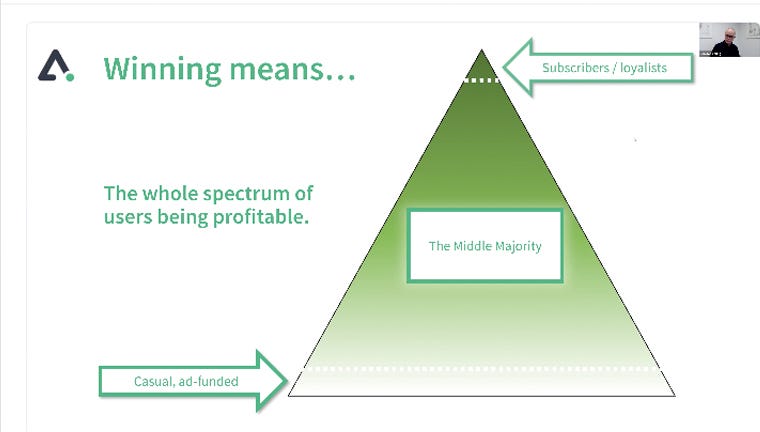
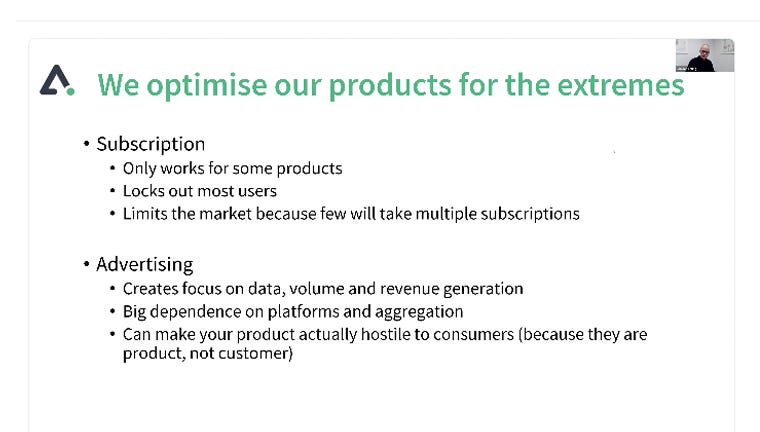
    “At the moment, there are publishers who are making a big success out of subscriptions and are making very high-margin revenues from their subscribers,” Young said. “But it’s quite difficult to get subscribers. You need a certain kind of product. There’s an awful lot of people trying to work the casual end of the market, ad-funded, trying to play all the games they can to maximise their ad revenue.”

    In the middle lies a huge amount of activity from what he calls the “Middle Majority,” publishers who are finding it very difficult to monetise their product.

    “The reality right now is that they have just sort of lost opportunities,” he said. “There’s a big gap in the middle, which is very, very hard to convert. Getting people from being casually engaged to becoming a subscriber is quite a leap.”

    This reality, Young argued, has distorted both media publishers’ products and their thinking, because they’re all forced to focus on the extremes — with subscription on one end and advertising on the other.

    However, this approach does not work because subscribers are too expensive to acquire and retain in a competitive environment — and subscriptions have a growth plateau. At the other end of the spectrum, advertising is impossible to scale enough to take on the big platforms, giving publishers little control, and the fixed market size creates the zero-sum game he spoke of.

    Middle majority = massive opportunity

    That middle majority space, however, is where the massive opportunity lies. “If the middle majority can become paying customers, we don’t have to change and disrupt the ad market. We don’t have to disrupt and change the subscription market. We can start to work up enough opportunities in between the two. And those opportunities, I think, add up to huge new revenues,” Young said.

    To take advantage of this opportunity, publishers must accomplish a few things.

    More people need to pay for media

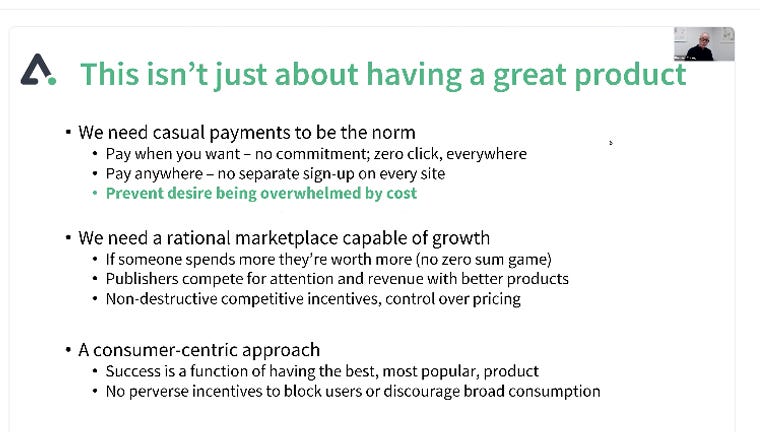
    “People will pay for things whenever the desire exceeds the cost,” Young said. This has proven particularly difficult for news media because the desire for it is brief, immediate, and frequent. “But the desire is relatively low, and the cost is almost always too high.”

    When the cost of access is too high, it overwhelms the desire and the user goes elsewhere. Young pointed out that cost is not just about the monetary price. It’s also about the process of paying and how much friction or time that entails, as well as the commitment being demanded of the user.

    “When desire exceeds cost, people will pay for things.” This leads to the question of how publishers can make sure desire exceeds cost.

    Better, user-focused media products and better price are the basic answers, Young says. “We should reward people who engage more deeply with the product — and it’s the product, not the content, that really matters. When you buy a newspaper, all of the content is different every day, but the newspaper is the same.”

    The product is the brand and what people learn to expect from it. Publishers should also encourage frequent return to the product to make it habit driven rather than commitment driven.

    When it comes to reducing cost, Young said publishers should charge what is right for their product and be aware of all costs, including the process of buying. This should be a zero-click process that makes payment as casual and easy as browsing. Reward engagement rather than punishing it by over-charging.

    It’s about more than having a great product

    “Returning to a world in which having a great product is the principal goal of being in business as a media company is the thing we all want to do,” Young said. “But there are some things we need in the environment before we can convert that to success.”

    “I think if we can connect quality product with revenue through audience, then media companies will become one of the most investable things on the whole Internet.”

    The biggest opportunity of all: Open up the network

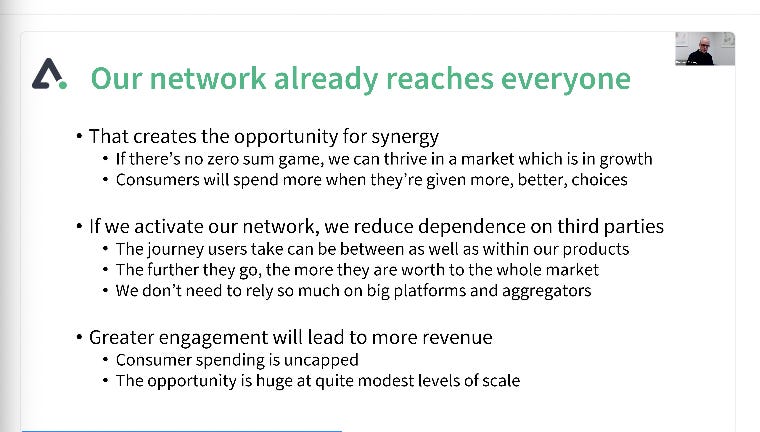
    The media network already reaches everyone, Young said. This creates an opportunity for synergy, and in the absence of a zero-sum game, publishers can thrive in a growth market.

    “That doesn’t mean we don’t need Google. It doesn’t mean we have to win a fight with Google. What it means is that people like Google and Facebook and everybody else become marketing channels for us.” Thus, the nature of the relationship between media publishers and these platforms will change dramatically.

    The consumer journey doesn’t have to be just about one product, but a flow from one thing to the next. This also means each individual publisher doesn’t have to do everything itself.

    Product thinking versus content thinking

    Young returned to the point that publishers must be product-focused rather than content focused:

    • Publisher content changes constantly. While the content must meet the user’s expectations, those expectations are created by the brand and overall product.
    • The redefinition of product as “content” is a trick. The Internet functions by breaking down products into content and then re-exploiting it, which amounts to a huge appropriation of value. Publishers can reclaim this by focusing on product.
    • While users can move from one piece of content to another, their journey is not random. Publishers provide readers a service by helping them choose their content journey, and the media network should take control of that journey collectively.

    “If the visit produces revenue, everything changes,” Young said. “We can design these different journeys, we can guide them within our products and between our products, and we can use the other players on the Internet as marketing channels [rather than competitors], which is what everyone else does.”

    This will give media organisations new incentives to collaborate and kick-start rapid evolution.

    “We can start right now, and we only need two things,” Young told the Webinar participants.

    1. The tools that enable this marketplace — a neutral player to sit in the middle and offer the same opportunities to everybody that wants to join the network. Other tools include the casual payments.
    2. Publishers — new and old — with great products.

    “Within a network, as long as everybody’s outcomes in terms of success are driven by the same things, the idea of perverse incentives driving perverse outcomes is much lower,” Young said. “I think if we, as media, connect and we find the right tools, this is a multi-billion dollar market.”

    Q&A

    INMA: What do you think our future relationship with the big platforms should be?

    Young: What big platforms have is a large number of users, but what they don’t have is a lot of content. If our relationship with the platforms means we can convert those users into paid customers, then what the relationship might mean is that we become advertisers.

    INMA: Can subscriptions sit alongside casual payments?

    Young: Yes. Casual payments are actually a way to encourage people to subscribe — try before you buy. We’re not making any claim that this is better than, or a substitution for, subscriptions. We’re just saying this opens up a part of the market.

    INMA: Is this mainly a young audience topic?

    Young: My impression that people paying for Netflix and Spotify are as much parents of younger people as they are the younger audience themselves.


    Originally published at https://www.inma.org on November 13, 2019.

  • This is a version of an article originally published in the Axate blog in February 2019

    The parlous state of journalism is mentioned frequently alongside such dark and contemporary issues as “fake news,” the increasing prevalence of nationalism and extremism, and electoral strangeness such as Brexit and Donald Trump.

    Enough people appear worried about the future of responsible, balanced, unbiased, public interest journalism, that it is being fatally undermined.

    The backdrop is a digital world in which consumers increasingly turn to Twitter, Facebook, Google, and others for news. With readers leaving the physical space of news — the tangible, touchable newspapers — and going online, it was hoped a new generation of digital papers could continue the quality offerings previously provided from the printing presses.

    But these new alternatives are at risk of being snuffed out. The huge rounds of job cuts at places like Buzzfeed and Mic, once carrying the hope that journalism can be reinvented for the digital age, has caused optimism to plunge yet further.

    Some thoughtful and useful analysis of the problem has been emerging.

    Dame Frances Cairncross in the UK was tasked by the Government with considering the question of what legislators could, and should, do to help the cause of journalism. Local journalism is especially deemed to need additional help.

    Cairncross’ report had some helpful, constructive, and well explained recommendations. They include tax breaks and a look at the competitive landscape surrounding advertising sales.

    But the overall tone is hardly optimistic. “…there are promising examples of innovations to bolster the provision of public-interest news, but these are unlikely to be sufficient” is the blunt assessment.

    The public interest isn’t enough to keep the public interested, Dame Cairncross seems to fear.

    Speaking as someone who is developing one of those innovations, I am a little more optimistic than Dame Frances.

    I am a little more optimistic than Dame Frances.

    I think the answer to what will save the media is the media itself. Great journalism can drive journalism back to its position of social and economic greatness if it has the right tools to generate the revenues it needs in response.

    For me the issue is simple. If we are going to make journalism more profitable, it needs to have more sources of revenue. Advertising is slipping away, so that can’t be it. The only other source of revenue is consumers themselves.

    This seems like an almighty challenge to many in the world of journalism, almost a holy grail. They have spent nearly three decades now trying and failing to create a sustainable business model and nothing has worked. Now that their whole businesses are failing this has become more than just a frustration, it has become a matter of survival.

    Subscriptions have been the best hope. Several big US newspaper sites have subscribers numbering in the millions, generating hundreds of millions of dollars of annual revenue. They are, by any measure, a huge success.

    However, the subscription model has limits. For a newspaper site to have millions of users, they have to turn away tens of millions who want their product but are unwilling to commit to paying for it every day. For most so called “content” sites, their product just isn’t right to persuade people to make a similar commitment, however popular it may be. For most consumers, promising to stay loyal to one product, and pay for it every month, it too big a price to pay for what is often just a casual desire to see something.

    The subscription model has limits

    This problem is seen up close in the Cairncross report. Local sites, it says, struggle to engage local people even when they’re available for free. No subscription offer will save them: there just aren’t enough people who will make the commitment. They’re stuck.

    Lots of ideas were mooted in response to this.

    The finger of blame for the malaise is often pointed at the big platforms (Facebook and Google, primarily) for robbing the publishers of audience and revenue. The answer proposed is to make them pay: force them to cough up some of their ill-gotten gains to help pay for the journalism they exploit.

    Another version of the same idea is the suggestion that some of the money paid to the BBC by licence fee payers should be diverted to pay for “public interest” journalism, reflecting and compensating for the distorting effect of the well-funded and always free news operation the BBC has on the internet.

    Cairncross swerves these suggestions, thankfully, so there’s no need to explain why I don’t think they won’t work (although I’ve explained that elsewhere if you’re interested).

    I think the answer is simpler.

    Consumer revenues are key, but subscriptions have limits. The opportunity for publishers lies with the “middle majority” of consumers who are willing to pay but unwilling to make the commitment of multiple — or any — subscriptions.

    The opportunity for publishers lies with the “middle majority” of consumers

    The opportunity is tantalising. There are tens of millions of UK consumers in this category. With the right product offered by publishers at the right price, they can not only become direct sources of revenue but the amount they spend is limited only by the ability of publishers to appeal to them. Given the amount of time people spend consuming media on their devices, that’s a pretty high ceiling.

    What is needed is the right tool so that any publisher can charge the right price for each part their product. The internet has been notably bad at developing this capability. While it’s still possible to walk into a newsagent and hand over a few coins in return for a newspaper or magazine, the online equivalent is nigh on impossible.

    Online you must sign up for each thing you want to buy. If you do (but most don’t), it’s a faff, form filling, and credit card entering. You must agree to subscribe — or at least trial a subscription and then remember to cancel it before it gets too expensive.

    Axate has made a tool to address this. It’s federated across as many publishers as want to implement it. They can price their product however they want and, once signed up, a consumer who has an Axate wallet can use it on any participating site, paying whatever small amount the publisher asks without any commitment to spendany more.

    With Axate, payment becomes an option for any publisher.

    With this tool in place, payment becomes an option for any publisher. They can put a price sticker on any of their products — allowing consumers to buy as little as one article.

    For this to succeed though, there needs to be a product worth paying for. No disappointed customer will ever come back for more

    That means the key challenge for publishers is a creative one, as it always used to be. Needing to focus on pleasing their consumer, not their advertisers, requires them to invest in differentiating their product and making it more appealing than their competitors.

    The challenge for publishers is to maintain standards so each visit by consumers will be deemed worthwhile, worth paying for, and crucially — worth coming back for more.

    The key challenge for publishers is a creative one

    This can be a liberating realisation for publishers. The editors of one of the sites we’re talking to, a local newspaper which has a close relationship with its audience, literally breathed a sigh of relief when they realized they could stop doing frequent but worthless short stories to generate traffic. They want to do fewer, longer and more relevant stories. Their plan is to spend more of their time and resource on things like the local council, local sports teams and local events, and ask their readers to pay a fair price.

    Success for them is both tantalising and achievable and I think they’re going to set the template for commercially successful local news. I think they can confound Dame Cairncross’ pessimism.

    Success for others is easy to see too, whether they’re digital businesses looking to diversify their dependence on advertising, or old-media companies reviving the fortunes of their well-known brands. Being able to set the right price, and all but eliminating the barriers for consumers, opens a world of liberating possibilities.

    This business model also means that publishers can generate more value by collaborating than through trying to lock users and products away behind walls and barriers.

    To return to the conundrum that Cairncross has been asked to wrestle with, at a simple level the answer is clear: we need more journalists well enough resourced to do the things they need to do. Inform, delight and entertain their consumers. Hold power to account without being easily cowed. Be driven by the trust of their readers, and fearful of the backlash if they ever break that trust.

    Journalism reached its greatest heights of power, influence, profitability and democratic conscience when millions of people developed a habit of spending tiny amounts of money, frequently, on their products. When they bought a newspaper two or three times a week, perhaps just on Saturday’s for the football, or on Sunday for the big political analysis.

    Great journalism can reach even more people now; and indeed it does. The internet has removed the need for huge infrastructure to enter the market so it can be more competitive and diverse than ever before.

    Axate has restored the ability for flexible payments to be the norm

    Axate has restored the ability for flexible payments to be the norm, not the exception, and for publishers to charge the right price — their price. The challenge now is creative. Who can create the best journalism and the best product?

    It’s going to be exciting finding out.

  • According to a recent article, the team at LadBible were wrestling with theproblem of modern publishing — making money.

    So what did they do?

    …[We] introduced a first-party data management platform that can monitor who has clicked through on an article, when and from what source. It also stores who they are, and when they return, the publisher can start to piece together a profile on them that’s contextual-based and includes individuals’ purchase intent, so they can offer more interest-based segments as well as track which people are interested in what content in order to send them a related ad within seconds while they’re still on the page. It uses IBM Watson’s natural language processing tech to scan its pages to help build the profiles and determine how best to categorize them.

    Source: Digiday

    Certainly complicated, undoubtedly sophisticated. But boil it down and it means that LadBible is getting smart about profiling their users. They can work out the ‘purchase intent’ of their users and sell that information to advertisers. Clever stuff, and a hard-won competitive advantage.

    There are two problems with it — and they are big ones.

    The first is that it is simply not sustainable. Ad-tech typically struggles to create advantages for long because it’s a brutal world in which the technology race is constantly re-run at breakneck speed.

    The second is that it runs counter to a clear trend to protect personal privacy in the digital world.

    As a consumer, I’m not sure I am comfortable with being profiled and my purchase intent being worked out, as a condition of reading about someone ending up in hospital because they did 1000 squats.

    That feels more than a little spooky. When I read something online it’s just because I want to, not to help someone work out what I want to buy before I know myself (and then advertise it to me).

    Consumers don’t like intrusive online advertising anyway. Nor is LadBible Argos or Amazon. People go there to read great content, not to shop.

    Other businesses don’t think like that. Starbucks ‘monetises’ its customers by selling them coffee. Aircraft manufacturers ‘monetise’ airlines by selling them planes.

    So for publishers, the principal source of future revenue has to be from their content and their consumers, not their advertisers.

    That’s not just because the ad game is impossible to win for long. It’s because you should sell what you make to people who value it.

    That would involve making a great product that their users wanted and enjoyed.

    It would involve drawing attention to it — marketing.

    It would involve encouraging and rewarding loyalty and habit.

    Most of all, it would involve charging the right price in the right way.

    Not via subscriptions. Too expensive, too committed. They work for some, relatively elite, brands but even they can only convert a small proportion of their audience.

    If there were options between the extremes of free and subscription, it might be easier to just charge people, casually, for your product.

    Then your business would be about finding as many people as you can who are willing to pay a fair price for a great product. The greatness of your product, the appropriateness of your price and the effectiveness of your marketing would be the key success factors. Not the short-term brilliance of your tech.

    Being able to charge the right price, and having the right product is key. Big platforms — Google and Facebook and co — wouldn’t then be enemies whose algorithms you spend days trying to game. They would be great partners to help attract attention to your product. It might be as easy as paying for ads, knowing that anyone who responds will be paying you a price you have set.

    If it’s so simple, why hasn’t it happened? Because the infrastructure, the common foundation needed to build it, simply doesn’t exist on the internet. It’s not the only missing piece of infrastructure on the internet, and my career has largely focused on identifying these gaps and trying to find solutions for them.

    One thing I have learned is that these problems don’t solve themselves spontaneously. Nor do solutions built for a single beneficiary fix the problem for anyone else. The shared capability needed to solve sector-wide problems needs to be delivered so that it can be used by everyone.

    In the case of this casual payment problem, that solution needs to provide a foundation for any and every publisher to build great and profitable products, which takse advantage of the internet’s incredible reach and efficiency. Without that common infrastructure for publishers, no network can grow.

    The same solution has to deliver for consumers too, of course. As well as being the right price, which might be very low, it needs to deliver something equally simple — an effortless way to pay. Payment should not be a wall. Being able to use the same method everywhere people go helps deliver that. It works for ordinary money, it works for payments in shops, the internet needs it too.

    I have spent the last couple of years stepping forward to meet this challenge and break the paralysis which others occurs when everyone waits for someone else to solve their problem. We have actually built something.

    And, guess what? It works. The feedback from consumers is hugely positive and the publishers we have launched with so far are all seeing user revenues they never had before.

    Solving this also offers new opportunities for all publishers to think differently about how they find their audience.

    Where better to suggest something you might like to read or watch next, than where you’re reading or watching something else? Publishers, rather than search and social platforms, have a new opportunity to define the journey you and I take around their products — there is mutual benefit in getting it right.

    So, casual payment for media doesn’t just solve an immediate problem for media who can’t win the monetisation game by the current rules. It also empowers their consumers, forces everyone to work harder to earn their spending and demands more investment by publishers, with success rewarded by more revenue.

    It works.

    Dominic Young, Founder & CEO, Axate

    Axate is a centralized digital wallet system that lets readers pay on an article-by-article basis. Users upload money to their Axate wallet and can spend it across Axate-enabled sites. Based in London, Axate was founded in 2017 by Dominic Young who previously held senior positions at News UK and News Corp.


    Originally published at https://whatsnewinpublishing.com on August 6, 2019.

  • Have you heard about the latest exciting European shenanigans?

    There’s a new Copyright Directive on the way, and boy has it stirred up some passions. There’s an absolutely massive campaign going on to stop it, and air around Brussels is thick with accusations and recriminations.

    Their arguments are impassioned, although anyone who takes the time to look for themselves will see that the changes proposed are not only relatively innocuous but also essential and positive.

    The interesting thing is who the arguments are being made by, and how they’re being made.

    The anti-copyright-directive gang are what we can now think of as the usual suspects, rehearsing the usual arguments.

    For example, author and journalist Cory Doctorow has stated that planned changes are an ‘unthinkable outcome’ which pose ‘an extinction-level event for the Internet’.

    Julia Reda’s pleas on behalf of her Pirate Party to #SaveTheInternet propose that Articles 11 and 13 should at the very least be radically amended, and scrapped entirely at the most.

    Jimmy Wales and Tim Berners-Lee signed an open letter which states that Article 13 would take ‘an unprecedented step towards the transformation of the internet from an open platform for sharing and innovation, into a tool for the automated surveillance and control of its users’.

    Even Stephen Fry has weighed in, calling the proposals ‘the EU’s looming internet catastrophe’. It is ‘not about protecting artists’ copyright’, he argues, but ‘about granting U.S. tech giants a license to dominate the internet’.

    These arguments, some of them simplistic, some ridiculous, some bordering on hysterical, all have the same central theme. They confidently predict that these changes will break the internet, render masses of things illegal or impossible, stop people doing the normal things they want to do. Rather gloomy and doomy, rather extreme and actually — under scrutiny — rather wrong. We heard it before with SOPA and PIPA, and earlier this year when this directive had its first vote.

    As well as impassioned arguments, the anti-directive campaigners have deployed technology to direct millions of emails and phone calls to EU legislators, purportedly from electors protesting the changes (although only a few hundred turned out to rallies around Europe in August).

    The people leading this are, in great part, people who at one time were pioneers, who could have staked a decent claim to represent the future. These one-time pioneers now a little grey haired and grumpy, their objectivity twisted by time, their affiliations and paymasters, old obsessions and quirky perspectives.

    The internet they dreamed of, and tried to make, was one which could easily change, which was in constant evolution, which produced greater and fairer opportunity and which gave everyone a voice and access to information and artistic endeavours.

    The internet we have now is, though, quite a long way from that utopian idyll. The online economy is dominated by a small number of companies who capture nearly all of the money and data (whether you know it or not) and who share little of it. Access to all the information in the world isn’t breaking people out of ever-tighter and more easily manipulated filter bubbles — controlled by the same US tech giants that Stephen Fry fears so much.

    Meanwhile, the right that everyone has to control their work — copyright — is worthless. Their work gets used without permission being sought, given or rewarded. So creators are going broke and creative companies are going bust.

    That is the status quo which these anti-copyright people are trying to preserve.

    Unable to paint an optimistic picture of a better, fairer Internet, they resort to predicting an Internet that is somehow even worse.

    Ridiculous and untrue as their nightmare scenarios are, they’re also hardly earth shattering. “This will be the end of memes” they claim.

    When weighed against the current undermining of copyright, creators’ loss of control over their own work and their inability to make a living from creativity, and the monopolisation of revenue by tax-avoiding mega-corporations, the loss of memes wouldn’t seem like a high price to pay — if it were true. But it’s not. As the Society of Authors points out, memes would be protected from copyright infringement as parody — and arguably other legal exceptions as well

    Other opponents have given similarly feeble arguments, criticising the current status quo without offering productive solutions. Wyclef Jean, founding member of The Fugees, has campaigned for change without actually proposing any change. In an article for Politico, he expresses the need to ‘team up and make the music community work better for everyone’ without ‘demonizing and tearing down the internet and responsible service providers’.

    “Links will be taxed”, they predict, absurdly. “The whole internet will be filtered by giant mega-corporations”. As if it isn’t already, but in any event, it won’t.

    Some of these doom-sayers can be easily explained away. They’re not neutral, they have a vested interest in the status quo even if they try to hide it. Google spends huge sums funding organisations and individuals who can defend its interests while feigning independence.

    Other activists are, dare i suggest it, just a bit past it. Stephen Fry, awash with cash, has no need for any Google largesse (and I’m sure receives none) and does not lack the intelligence to understand the arguments. Nevertheless, he still argues for the status quo. Perhaps having lived through the heady early days of the internet he just lacks the energy for any more change.

    The internet as we know it now is still unevolved, primitive and brutal. It’s unfair and it farms its individual users as if they’re cash crops for the few.

    We need to believe that it can change for the better. Restoring the rights of individuals is a key starting point for that.

    Anyone who argues, fearfully, that change cannot be good and must be resisted is either being disingenuous or has simply stood by as time has rushed past them and find themselves now looking around and wishing it would stop.

    Support the copyright directive, support the rights of individuals, support a fair internet which functions for all its participants.

    Imagine it better, then make it happen.


    Originally published at http://copyrightblog.co.uk on September 11, 2018.

  • Have you heard about the latest exciting European shenanigans? 

    There’s a new Copyright Directive on the way, and boy has it stirred up some passions. There’s an absolutely massive campaign going on to stop it, and air around Brussels is thick with accusations and recriminations. 

    Their arguments are impassioned, although anyone who takes the time to look for themselves will see that the changes proposed are not only relatively innocuous but also essential and positive.

    The interesting thing is who the arguments are being made by, and how they’re being made.

    The anti-copyright-directive gang are what we can now think of as the usual suspects, rehearsing the usual arguments.

    For example, author and journalist Cory Doctorow has stated that planned changes are an ‘unthinkable outcome’ which pose ‘an extinction-level event for the Internet’.

    Julia Reda’s pleas on behalf of her Pirate Party to #SaveTheInternet propose that Articles 11 and 13 should at the very least be radically amended, and scrapped entirely at the most.

    Jimmy Wales and Tim Berners-Lee signed an open letter which states that Article 13 would take ‘an unprecedented step towards the transformation of the internet from an open platform for sharing and innovation, into a tool for the automated surveillance and control of its users’.

    Even Stephen Fry has weighed in, calling the proposals ‘the EU’s looming internet catastrophe’. It is ‘not about protecting artists’ copyright’, he argues, but ‘about granting U.S. tech giants a license to dominate the internet’.

    These arguments, some of them simplistic, some ridiculous, some bordering on hysterical, all have the same central theme. They confidently predict that these changes will break the internet, render masses of things illegal or impossible, stop people doing the normal things they want to do. Rather gloomy and doomy, rather extreme and actually – under scrutiny – rather wrong. We heard it before with SOPA and PIPA, and earlier this year when this directive had its first vote.

    As well as impassioned arguments, the anti-directive campaigners have deployed technology to direct millions of emails and phone calls to EU legislators, purportedly from electors protesting the changes (although only a few hundred turned out to rallies around Europe in August).

    The people leading this are, in great part, people who at one time were pioneers, who could have staked a decent claim to represent the future. These one-time pioneers now a little grey haired and grumpy, their objectivity twisted by time, their affiliations and paymasters, old obsessions and quirky perspectives.

    The internet they dreamed of, and tried to make, was one which could easily change, which was in constant evolution, which produced greater and fairer opportunity and which gave everyone a voice and access to information and artistic endeavours. 

    The internet we have now is, though, quite a long way from that utopian idyll. The online economy is dominated by a small number of companies who capture nearly all of the money and data (whether you know it or not) and who share little of it. Access to all the information in the world isn’t breaking people out of ever-tighter and more easily manipulated filter bubbles – controlled by the same US tech giants that Stephen Fry fears so much.

    Meanwhile, the right that everyone has to control their work – copyright – is worthless. Their work gets used without permission being sought, given or rewarded. So creators are going broke and creative companies are going bust.

    That is the status quo which these anti-copyright people are trying to preserve.

    Unable to paint an optimistic picture of a better, fairer Internet, they resort to predicting an Internet that is somehow even worse.

    Ridiculous and untrue as their nightmare scenarios are, they’re also hardly earth shattering. “This will be the end of memes” they claim.

    When weighed against the current undermining of copyright, creators’ loss of control over their own work and their inability to make a living from creativity, and the monopolisation of revenue by tax-avoiding mega-corporations, the loss of memes wouldn’t seem like a high price to pay – if it were true. But it’s not. As the Society of Authors points out, memes would be protected from copyright infringement as parody – and arguably other legal exceptions as well

    Other opponents have given similarly feeble arguments, criticising the current status quo without offering productive solutions. Wyclef Jean, founding member of The Fugees, has campaigned for change without actually proposing any change. In an article for Politico, he expresses the need to ‘team up and make the music community work better for everyone’ without ‘demonizing and tearing down the internet and responsible service providers’.

    “Links will be taxed”, they predict, absurdly. “The whole internet will be filtered by giant mega-corporations”. As if it isn’t already, but in any event, it won’t.

    Some of these doom-sayers can be easily explained away. They’re not neutral, they have a vested interest in the status quo even if they try to hide it. Google spends huge sums funding organisations and individuals who can defend its interests while feigning independence.

    Other activists are, dare i suggest it, just a bit past it. Stephen Fry, awash with cash, has no need for any Google largesse (and I’m sure receives none) and does not lack the intelligence to understand the arguments. Nevertheless, he still argues for the status quo. Perhaps having lived through the heady early days of the internet he just lacks the energy for any more change.

    The internet as we know it now is still unevolved, primitive and brutal. It’s unfair and it farms its individual users as if they’re cash crops for the few. 

    We need to believe that it can change for the better. Restoring the rights of individuals is a key starting point for that. 

    Anyone who argues, fearfully, that change cannot be good and must be resisted is either being disingenuous or has simply stood by as time has rushed past them and find themselves now looking around and wishing it would stop.

    Support the copyright directive, support the rights of individuals, support a fair internet which functions for all its participants.

    Imagine it better, then make it happen.

  • “Netflix for News”. That’s a phrase I’ve started hearing in the last month.

    It refers to an idea about how to save the news industry. I think most people who say it are suggesting a single subscription which users would pay, but which would give them access a wide range of news sites — a kind of super-subscription.

    If we take a business model which has had recent success elsewhere in the media, the idea goes, we would solve everything.

    Spotify has done it for music, Netflix have done it for TV and movies, why not do it for news? Subscribers would be paying, news organisations would have a new revenue source, and online media would be saved. Hurrah.

    It’s easy to see why this idea has surfaced. Spotify has been at the forefront of transforming an industry ravaged by piracy into one that has returned to growth, with streaming increasingly driving it. Netflix is putting unprecedented amounts of money into amazing new commissions.

    The news industry most definitely needs to drive direct consumer revenues, and so dreams of similar things happening.

    Seems simple. Will it work?

    Well… there are a few reasons why it might not be the ideal model.

    Firstly, to state the obvious, music and TV are quite different from news. Music persists in a way that news does not. One person might listen to the same piece of music tens — or even hundreds — of times and still enjoy it.

    People spend hours bingeing on box sets, sometimes years old. The ‘value-creating life’ of music, especially popular music, can be as long as decades, with TV and movies not far behind.

    News, in comparison, tends to be short-lived. Its value-creating life can be as short as minutes or hours. Very few news stories hold significant economic value (or attention) for longer than a few days or weeks.

    This means the model for getting payback has to be different. News requires constant re-investment by news companies to continue to have value, which needs be realised immediately. The investment and payback cycle for other media is typically a lot slower.

    Is all news equally valuable?

    In addition, news products tend to have more variable pricing. Unlike music, which broadly costs the same regardless of what it is, newspapers have always had highly differentiated pricing and products.

    How do you equate the value of The Sun and The Times? Are they worth the same? Does someone reading one long article in The Times account for the same amount of value as someone else reading a short one in The Sun?

    This is the challenge faced in a super-subscription environment, where the user pays the same regardless of what they read or how much they read.

    How do you divide it fairly? Who should get what? And how do you ensure that making more investment in content, and getting it more widely read, delivers more revenue? Without that promise, why would anyone invest in expensive content instead of cheaper commodified stuff? You only have to look at today’s internet to see the answer to that question.

    Algorithmic perversity

    A super-subscription business model means that an algorithm decides how much individual news products are worth. It’s impossible to make an algorithm for this without producing perverse outcomes — I speak from experience.

    If your algorithm pays publishers based on how many articles get read, publishers with long reads get punished. If it rewards “dwell time”, publishers who are good at producing very pithy articles get punished. If it tries to identify a user’s favourite publication and give it a bigger share, other unfairly lose out.

    Algorithms like this, however sophisticated, create winners and losers and limit the ability of publishers to diversify their products and business models. On the contrary, they incentivise publishers to adjust their product in order to game the algorithm, rather than to please their reader.

    That quickly becomes messy, so to minimise it, the provider needs to keep the algorithm opaque and ever-changing. The whole business model becomes shrouded in mystery. Nobody can ever know quite how the amount they are being paid has been calculated.

    If you want to see that problem come to life, just look at how the Google search algorithm and advertising algorithms work. Key to the way they function, and acquire power in the market, is that almost nothing is disclosed about the way they function. Nobody is allowed to know quite how they operate. Those who control the algorithm are totally in control.

    Not quite as simple as it looks

    So “Spotifying” or “Netflixiating” news has a few challenges, even at a glance.

    Perhaps they might be reduced by ensuring there are a number of competing services out there. This, though, raises its own issues.

    For example, if services try to compete by doing exclusive deals with publishers, consumers will be left with a choice of incomplete services and might end up having to subscribe to several of them in order to get access to everything they want. Sound familiar to any Netflix and Amazon Prime fans? But if all the competing services have essentially the same offer, how many of them will survive? A competitive market for this sort of thing can be hard to sustain in reality and the consumer offer will be damaged.

    So what’s the upside?

    There is one outstandingly good thing, though, about these super-subscription models.

    They are good at signing up large numbers of subscribers. If you want a subscription product to get to millions of customers, keep the price low — £10 per month or less is what you’re aiming for — give consumers a big choice of content, all included, and try to be the one subscription everyone needs. You’ll find loads of takers.

    By comparison, it’s much harder to get people to commit to a relatively restricted product (like a single newspaper, for example) than a massive offering. That’s why subscription success tends to be limited to an exclusive group of high value publishers with affluent audiences.

    The largest barrier to making subscription models work is getting that commitment from readers, so giving an immense amount of content in return is a good way to get them to pay.

    Even if you could make it work, you shouldn’t want to

    But there’s still a huge, massive problem with the whole idea of super-subscriptions.

    Once you’ve persuaded all the publishers to take part, and you have the subscribers signed up, and you’ve developed a really compelling product and user proposition, and you have written an algorithm which divides the money up fairly, and you have managed to find a way to put high-priced, low volume products alongside low-priced, high volume products in the same service without any of them crying foul — none of which is easy — you still have to face the fact that you — and the publishers — have a terrible business.

    Why?

    Because you have set an upper limit on how big it can be. That limit is your subscription price. £10 per month, multiplied by the number of users you can sign up. You have to divide that £10 between all the publishers, and try to have some money left over for yourself.

    That money will all be spoken for the day you go on sale. And there won’t be much left over to pay to new publishers who want to come and join in the fun. For them to get anything, you have to take it away from someone else, or try to increase price (and prevent the existing publishers from claiming the increase for themselves). Or the late joining publishers have to rely on advertising revenue — and we all know the issues with that.

    It’s revenue, but it’s not a thriving market

    So, this model produces some new revenue for the industry. Which is a good thing.

    However, the revenue doesn’t increase in response to more content being consumed. It just gets shared more thinly between publishers, just as ad revenue does now. Not such a great thing if you want to see a bigger and more competitive market. More importantly, it reduces the rationale for investing more in content.

    In a future “Spotified” world where total income is fixed, the incentive will still be to do exactly the same thing as now — minimise cost, maximise consumption, depend on advertising to drive revenue increases. It will just have an underlying, new, base layer of customer revenue which will only grow as long as new customers are acquired and retained.

    It will not lead to a greater incentive to invest in product and content, because the market and opportunity will not grow any bigger in response to that investment. Not only is revenue limited by subscription rates in a “Spotified” world; so is market growth.

    Super-subscriptions would be first aid for dying news brands, but not a cure

    So, in my view, this model will solve little. It will give the existing players a temporary reprieve, but leaves an internet still far from the vibrant, thriving market it could be. The door is closed to new entrants, because the fixed revenue — the subscription price — means publishers who are involved will defend their share.

    Be more ambitious, create a market which can thrive

    There is a much more exciting, compelling and tantalising opportunity which publishers and regulators should focus on instead.

    Imagine, if you dare, an internet in which every time a consumer reads something (or listens, or watches, or plays) the publisher makes some money. The more people consume their product, the more money they make.

    What would happen?

    Well… the best content, well produced, well marketed and wisely priced, would make the most money.

    Which means the incentive to invest would change radically. We would see a lot more competition for users’ attention (and money). More products would be launched, and creative innovators incentivised to make their content compelling because they’re offered a direct reward.

    Consumers would, in turn, increase their consumption because they’ve been given an ever more exciting choice of content to choose from. The market would grow every time someone decided to read more content. The job of the creators would be to get ever more creative about how to get them to engage more. And there are no limits set on the potential revenue for online content.

    Publishers win big, consumers win bigger

    But what about the poor old consumer, suddenly facing all this in place of what used to be free?

    They’re actually the biggest winner of all. Being the source of the money places consumers in control — they become the masters of the algorithm. Nobody is going to part with their cash — or their data — unless what they get in return is worth it. Disappoint your customer and your business will suffer; please them and you win a huge prize.

    This is happening right now

    If you want to know how this can be achieved, I have spent the last year building the answer to that.

    It’s called Axate, and you can try it now.


    Originally published at http://copyrightblog.co.uk on August 16, 2018.

  • “Netflix for News”. That’s a phrase I’ve started hearing in the last month.

    It refers to an idea about how to save the news industry. I think most people who say it are suggesting a single subscription which users would pay, but which would give them access a wide range of news sites – a kind of super-subscription.

    If we take a business model which has had recent success elsewhere in the media, the idea goes, we would solve everything.

    Spotify has done it for music, Netflix have done it for TV and movies, why not do it for news? Subscribers would be paying, news organisations would have a new revenue source, and online media would be saved. Hurrah.

    It’s easy to see why this idea has surfaced. Spotify has been at the forefront of transforming an industry ravaged by piracy into one that has returned to growth, with streaming increasingly driving it. Netflix is putting unprecedented amounts of money into amazing new commissions.

    The news industry most definitely needs to drive direct consumer revenues, and so dreams of similar things happening.

    Seems simple. Will it work?

    Well… there are a few reasons why it might not be the ideal model.

    Firstly, to state the obvious, music and TV are quite different from news. Music persists in a way that news does not. One person might listen to the same piece of music tens – or even hundreds – of times and still enjoy it.

    People spend hours bingeing on box sets, sometimes years old. The ‘value-creating life’ of music, especially popular music, can be as long as decades, with TV and movies not far behind.

    News, in comparison, tends to be short-lived. Its value-creating life can be as short as minutes or hours. Very few news stories hold significant economic value (or attention) for longer than a few days or weeks.

    This means the model for getting payback has to be different. News requires constant re-investment by news companies to continue to have value, which needs be realised immediately. The investment and payback cycle for other media is typically a lot slower.

    Is all news equally valuable?

    In addition, news products tend to have more variable pricing. Unlike music, which broadly costs the same regardless of what it is, newspapers have always had highly differentiated pricing and products.

    How do you equate the value of The Sun and The Times? Are they worth the same? Does someone reading one long article in The Times account for the same amount of value as someone else reading a short one in The Sun?

    This is the challenge faced in a super-subscription environment, where the user pays the same regardless of what they read or how much they read.

    How do you divide it fairly? Who should get what? And how do you ensure that making more investment in content, and getting it more widely read, delivers more revenue? Without that promise, why would anyone invest in expensive content instead of cheaper commodified stuff? You only have to look at today’s internet to see the answer to that question.

    Algorithmic perversity

    A super-subscription business model means that an algorithm decides how much individual news products are worth. It’s impossible to make an algorithm for this without producing perverse outcomes – I speak from experience.

    If your algorithm pays publishers based on how many articles get read, publishers with long reads get punished. If it rewards “dwell time”, publishers who are good at producing very pithy articles get punished. If it tries to identify a user’s favourite publication and give it a bigger share, other unfairly lose out.

    Algorithms like this, however sophisticated, create winners and losers and limit the ability of publishers to diversify their products and business models. On the contrary, they incentivise publishers to adjust their product in order to game the algorithm, rather than to please their reader.

    That quickly becomes messy, so to minimise it, the provider needs to keep the algorithm opaque and ever-changing. The whole business model becomes shrouded in mystery. Nobody can ever know quite how the amount they are being paid has been calculated.

    If you want to see that problem come to life, just look at how the Google search algorithm and advertising algorithms work. Key to the way they function, and acquire power in the market, is that almost nothing is disclosed about the way they function. Nobody is allowed to know quite how they operate. Those who control the algorithm are totally in control.

    Not quite as simple as it looks

    So “Spotifying” or “Netflixiating” news has a few challenges, even at a glance.

    Perhaps they might be reduced by ensuring there are a number of competing services out there. This, though, raises its own issues.

    For example, if services try to compete by doing exclusive deals with publishers, consumers will be left with a choice of incomplete services and might end up having to subscribe to several of them in order to get access to everything they want. Sound familiar to any Netflix and Amazon Prime fans? But if all the competing services have essentially the same offer, how many of them will survive? A competitive market for this sort of thing can be hard to sustain in reality and the consumer offer will be damaged.

    So what’s the upside?

    There is one outstandingly good thing, though, about these super-subscription models.

    They are good at signing up large numbers of subscribers. If you want a subscription product to get to millions of customers, keep the price low – £10 per month or less is what you’re aiming for – give consumers a big choice of content, all included, and try to be the one subscription everyone needs. You’ll find loads of takers.

    By comparison, it’s much harder to get people to commit to a relatively restricted product (like a single newspaper, for example) than a massive offering. That’s why subscription success tends to be limited to an exclusive group of high value publishers with affluent audiences.

    The largest barrier to making subscription models work is getting that commitment from readers, so giving an immense amount of content in return is a good way to get them to pay.

    Even if you could make it work, you shouldn’t want to

    But there’s still a huge, massive problem with the whole idea of super-subscriptions.

    Once you’ve persuaded all the publishers to take part, and you have the subscribers signed up, and you’ve developed a really compelling product and user proposition, and you have written an algorithm which divides the money up fairly, and you have managed to find a way to put high-priced, low volume products alongside low-priced, high volume products in the same service without any of them crying foul – none of which is easy – you still have to face the fact that you – and the publishers – have a terrible business.

    Why?

    Because you have set an upper limit on how big it can be. That limit is your subscription price. £10 per month, multiplied by the number of users you can sign up. You have to divide that £10 between all the publishers, and try to have some money left over for yourself.

    That money will all be spoken for the day you go on sale. And there won’t be much left over to pay to new publishers who want to come and join in the fun. For them to get anything, you have to take it away from someone else, or try to increase price (and prevent the existing publishers from claiming the increase for themselves). Or the late joining publishers have to rely on advertising revenue – and we all know the issues with that.

    It’s revenue, but it’s not a thriving market

    So, this model produces some new revenue for the industry. Which is a good thing.

    However, the revenue doesn’t increase in response to more content being consumed. It just gets shared more thinly between publishers, just as ad revenue does now. Not such a great thing if you want to see a bigger and more competitive market. More importantly, it reduces the rationale for investing more in content.

    In a future “Spotified” world where total income is fixed, the incentive will still be to do exactly the same thing as now – minimise cost, maximise consumption, depend on advertising to drive revenue increases. It will just have an underlying, new, base layer of customer revenue which will only grow as long as new customers are acquired and retained.

    It will not lead to a greater incentive to invest in product and content, because the market and opportunity will not grow any bigger in response to that investment. Not only is revenue limited by subscription rates in a “Spotified” world; so is market growth.

    Super-subscriptions would be first aid for dying news brands, but not a cure

    So, in my view, this model will solve little. It will give the existing players a temporary reprieve, but leaves an internet still far from the vibrant, thriving market it could be. The door is closed to new entrants, because the fixed revenue – the subscription price – means publishers who are involved will defend their share.

    Be more ambitious, create a market which can thrive

    There is a much more exciting, compelling and tantalising opportunity which publishers and regulators should focus on instead.

    Imagine, if you dare, an internet in which every time a consumer reads something (or listens, or watches, or plays) the publisher makes some money. The more people consume their product, the more money they make.

    What would happen?

    Well… the best content, well produced, well marketed and wisely priced, would make the most money.

    Which means the incentive to invest would change radically. We would see a lot more competition for users’ attention (and money). More products would be launched, and creative innovators incentivised to make their content compelling because they’re offered a direct reward.

    Consumers would, in turn, increase their consumption because they’ve been given an ever more exciting choice of content to choose from. The market would grow every time someone decided to read more content. The job of the creators would be to get ever more creative about how to get them to engage more. And there are no limits set on the potential revenue for online content.

    Publishers win big, consumers win bigger

    But what about the poor old consumer, suddenly facing all this in place of what used to be free?

    They’re actually the biggest winner of all. Being the source of the money places consumers in control – they become the masters of the algorithm. Nobody is going to part with their cash – or their data – unless what they get in return is worth it. Disappoint your customer and your business will suffer; please them and you win a huge prize.

    This is happening right now

    If you want to know how this can be achieved, I have spent the last year building the answer to that.

    It’s called Agate, and you can try it now on publications like The New EuropeanPopbitch and Reaction.life – and many more to come.

  • As some people will notice, my flurries of activity on this blog and elsewhere are somewhat random. I am deeply passionate about the issues around copyright, because they impinge so heavily on so many other things – economic, cultural, political, personal. One of the reasons I have written about it is to try to explain why these things matter.

    The other reason is because I can see how things can be better.

    Seeing how things could be better demands more than just sitting on a blog being a smart-arse. Instead of just writing about it, I need to DO something about it?

    After all, one of the reasons the creative industries have found themselves in such dire straits is that while they have been adept at identifying their problems and pointing the finger of blame in various directions, they have been slow to come forward with – and actually implement – solutions.

    The extended silence is because I have been doing just that.

    Solving things for the creative industry is really about putting the creators and those who turn their work into products (the publishers, I guess) at the top of the economic pile. They’re the apex value-creators, after all, but on the internet they are far from the biggest earners.

    Part of that is about copyright – the way permission is traded for value between, mainly, creators and publishers (and the main focus of this blog). Also the way those who don’t have permission are prevented from exploiting other peoples’ work. We all know how broken that is, and the many projcts (including some inspired and initiated by me) which seek to address it.

    But at the other end of the issue there’s perhaps a more fundamental problem which needs to be solved.

    How to get money into the value chain in the first place. The money that flows from advertising is largely inaccessible to publishers, controlled by huge platforms and leading to weird product decisions to try to maximise the paltry revenue flow.

    The other revenue stream – from users – has been elusive for publishers. It’s a common belief that people don’t want to pay to access media content. That’s not particularly surprising that only a tiny proportion of people actually DO pay. Only 7% of people in the UK have paid for online news in the last year, according to the Reuters Institute – a number which seems, sadly, rather high to me.

    That is the problem I have set out to solve. Free doesn’t work, but subscriptions are only taken up by a tiny proportion of the audience.

    The 95% of activity which subscriptions fail to reach is a huge opportunity. Asking consumers to pay without asking them to make a formal commitment is a way to start making money in that huge space. Making it effortless is essential.

    That’s what the product I have built does. It’s called Agate and you can try it now at Popbitch – go to www.popbitch.com/stories and start reading.

    Pretty soon you’ll be able to take it to other sites too, without any further setup or login or any such nonsense.

    I hope you like it, and if you do I hope you spread the word (and add @agatehq to your tweets and follow list).

    So, I’m making it easier to make money, at prices and on terms that publishers control.

    After that the challenge is for the creators and publishers. Can they make something you like enough to want to spend a few pence on? If they can, the prize is pretty big.

    That makes pleasing you becomes their most important objective. Not so much pleasing the advertisers.

    What a relief and a pleasure that will be!

  • Finally the emperor has no clothes. The creative media will never be able to adapt to the internet the way it is now. More and more people are saying it. Media is dying.

    Why? Because it’s starving. There simply isn’t enough money to pay for everything. However good the media has been at garnering audiences and data, the impossibility of trading those things for meaningful amounts of money has become apparent to even the most optimistic enthusiasts.

    Without money, media withers and dies. Newspapers, with a few stand-out exceptions, are withering away at an alarming rate. Magazines, long dependent on their print editions to keep going, have hit a wall.

    The simple and seductive idea that advertising could translate internet popularity into money has proved itself wrong. We need not dwell on the reasons other than to observe that that advertising isn’t working, and has never really worked, as a sustainable revenue source for online media. After roughly twenty years waiting and hoping that things might change, the patience and financial reserves of the media have begun to run out.

    Which leaves a gloriously simple problem. The media needs to make more money. It needs to translate audience into revenue.

    If advertising can’t do it, what can?

    There’s only one other source of money and that is the audience themselves. The stand-out exceptions I mentioned above are thriving because they’re charging for access. The London Times, the Washington Post, the Economist and so on.

    For them, subscriptions are the central focus. The Times of London is profitable for the first time in living memory as a result of its obsessive, long term, subscription focus.

    The only way customers can be persuaded to pay, and keep paying, is if The Times focuses on nothing more than producing a product which entertains, informs, delights and surprises them. That is great news for customers. The Times has to be trustworthy. It has to be consistent. It has to be, and to stay, excellent or people will simply decide not to pay for it.

    The same is not true of free products, which need to capture enough readers to generate data to sell to advertisers.  They often do this by generating “click-bait” stories, which, as the name indicates, are a form of con and hostile to readers.  Free products need to display as many ads as they possibly can to maximise the (still pitiful) revenue that data can generate. They need to cut their investment in content and the creators who make it, to try to make ends meet, thereby short-serving their readers.

    So even if being asked to pay seems, initially, like a bad option, it turns out that for a significant numbers of users it is not. But only if the product is good enough to justify the cost.

    That’s an important factor for publishing people to consider when they find themselves thinking “but nobody will be willing to pay”. It is surely true that persuading people to pay for a product which has been optimised for being free, and in the process become unsatisfying and hostile, is tough. But it’s not a generic truth that people won’t pay.

    People will pay. They’ll pay for anything for which their desire exceeds the cost being demanded – whether it’s media, groceries, cars or jewellery. The amount of desire, the acceptable cost and the product might vary from person to person, but it is that basic equation which drives all consumer markets.

    The task of the media is to bring cost and desire for their products into line.

    If the cost has to be more than zero in order to remain in business, what has to happen to the product to make it viable? Self-evidently it has to be attractive to enough customers. That probably involves more change than simply putting a price sticker on it. But where there’s a return there’s a business plan. Investment to make the product better is justified by the improved bottom line that stands to be gained.

    Lastly, what about the cost? The Times and others have shown the way by creating a high value product that sells, to hundreds of thousands of people. They have found a lot of people willing to part with a fair amount of money every month because their desire for the The Times exceeds the cost being asked.

    It isn’t cheap, though. The Times is most certainly a high-end product aimed at affluent individuals. That’s why the subscription base is somewhere below 10% of the people who want might otherwise choose to read their product. The other 90+% just have to be ignored, or, in some cases given a certain amount of free content in order to tempt them in.

    For other publishers, with larger and less affluent or less committed audiences, the investment in making the product more desirable has to be justified by a price much, much lower than the subscriptions currently doing so well at the very top of the market which appeals to a much broader demographic.

    Lowering that cost and creating really huge new sources of revenue and profit is the next challenge.

    Which will be the subject of the next blog…